MAJOR OCEAN CURRENTSLearning Objective: | Identify the major ocean currents and their locations, and recognize their effects on the weather. |
The major ocean currents are established and maintained by the stresses exerted by the prevailing winds. Thus, the oceanic circulation pattern roughly corresponds to Earth’satmospheric circulation pattern. Since the air circulation over the oceans in the middle latitudes is chiefly anticyclonic (more pronounced in the Southern Hemisphere than in the Northern Hemisphere), the oceanic circulation is more or less the same.At higher latitudes, where the windflow is principally cyclonic, the oceanic circulation follows this pattern, although not as closely as the anticyclonic pattern of the middle latitudes.In regions of pronounced monsoonal flow, the monsoon winds control the currents. The general distribution of ocean currents is as follows:At middle (below 40° lat.) and low latitudes, warm currents flow poleward along the eastern coasts of continents and cold currents flow equatorward along the western coasts. This is true in both hemispheres.In the Northern Hemisphere at high latitudes, cold currents flow equatorward along the east coasts of continents, and warm currents flow poleward along the western coasts.In monsoonal regions, ocean currents vary with the seasons, and irregular coastlines can cause deviations in the general distribution of ocean currents.
The oceanic circulation pattern acts to transport heat from one latitude belt to another in a manner similar to the heat transported by the primary circulation of the atmosphere. 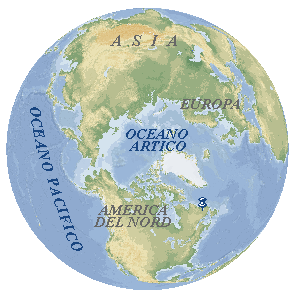 The cold waters of the Arctic and Antarctic move equatorward toward warmer water, while the warm waters of the lower latitudes move poleward. The effect this circulation pattern has on climate can be seen in the comparatively mild climate that exists in the area of northwest Europe. Even in winter, Norwegian ports along the Atlantic are ice-free most of the time. The cold waters of the Arctic and Antarctic move equatorward toward warmer water, while the warm waters of the lower latitudes move poleward. The effect this circulation pattern has on climate can be seen in the comparatively mild climate that exists in the area of northwest Europe. Even in winter, Norwegian ports along the Atlantic are ice-free most of the time.This is due to the effect of the warm ocean current that sweeps (si estende) northward along the Norwegian coast. In contrast, a cold ocean current flows equatorward along the coast of California and is a major reason that cities such as San Francisco experience relatively cool summer temperatures. Figure 1-1-3 shows the surface currents of the oceans during February and March.
|

