DEEP-OCEAN CIRCULATIONMethods devised (escogitati) to determine deep-ocean circulation have met with varying success, but all point to a quite complex pattern of subsurface currents. The deep-ocean currents differ from surface currents in that they (1) are density driven, (2) are much slower, (3) move in a predominantly north-south direction, and (4) they cross the equator.
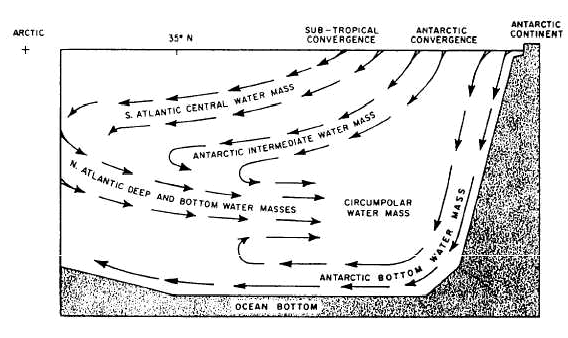 The deep-ocean circulation is often referred to as a thermohaline circulation, because the circulation is controlled by differences in temperature and salinity. Varying combinations of temperature and salinity produce water of varying densities, and it is these density differences that produce the deep-ocean circulation. Since the majority of the world’s water masses are formed at the surface, our discussion of the deep-ocean circulation must start here. We will move through the circulatory pattern, beginning and ending with the surface waters around Antarctica. As the high density surface water around Antarctica sinks, it mixes with the warmer, more saline circumpolar water to form Antarctic bottom water. See figure 1-2-5. Because Antarctic bottom water is the most dense water found in the ocean, it sinks to the ocean floor and spreads, or flows, northward into the deep-ocean basins of the Atlantic, Pacific, and Indian Oceans. This water mass has been tracked as far north as the 35th parallel of the Northern Hemisphere. The deep-ocean circulation is often referred to as a thermohaline circulation, because the circulation is controlled by differences in temperature and salinity. Varying combinations of temperature and salinity produce water of varying densities, and it is these density differences that produce the deep-ocean circulation. Since the majority of the world’s water masses are formed at the surface, our discussion of the deep-ocean circulation must start here. We will move through the circulatory pattern, beginning and ending with the surface waters around Antarctica. As the high density surface water around Antarctica sinks, it mixes with the warmer, more saline circumpolar water to form Antarctic bottom water. See figure 1-2-5. Because Antarctic bottom water is the most dense water found in the ocean, it sinks to the ocean floor and spreads, or flows, northward into the deep-ocean basins of the Atlantic, Pacific, and Indian Oceans. This water mass has been tracked as far north as the 35th parallel of the Northern Hemisphere.
In the sub-Arctic regions of the Northern Hemisphere, the same type of process occurs. The cold, 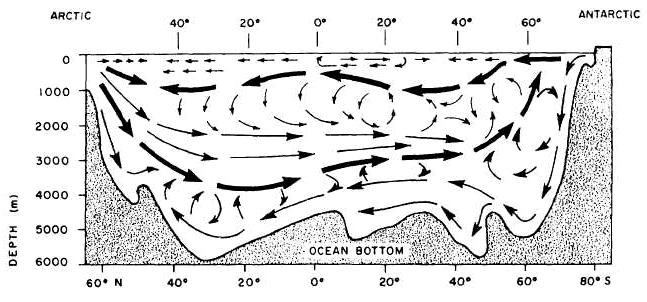 dense surface water sinks and forms North Atlantic deep and bottom water. This water mass spreads southward and is in contact with the bottom, except where it encounters Antarctic bottom water. (See figure 1-2-6.) Being less dense than Antarctic bottom water, it is found above Antarctic bottom water wherever the two exist together. The North Atlantic deep and bottom water eventually makes its way back to the Antarctic Ocean, where it mixes with intermediate water masses and Antarctic bottom water to form Antarctic circumpolar water. Here, the cycle begins again as the cold, dense surface water of Antarctica sinks and mixes with the circumpolar water. Above the deep and bottom waters, the intermediate water masses also show a basic equatorward movement. Antarctic intermediate water actually crosses the equator and moves as far north as 20° to 35°N. dense surface water sinks and forms North Atlantic deep and bottom water. This water mass spreads southward and is in contact with the bottom, except where it encounters Antarctic bottom water. (See figure 1-2-6.) Being less dense than Antarctic bottom water, it is found above Antarctic bottom water wherever the two exist together. The North Atlantic deep and bottom water eventually makes its way back to the Antarctic Ocean, where it mixes with intermediate water masses and Antarctic bottom water to form Antarctic circumpolar water. Here, the cycle begins again as the cold, dense surface water of Antarctica sinks and mixes with the circumpolar water. Above the deep and bottom waters, the intermediate water masses also show a basic equatorward movement. Antarctic intermediate water actually crosses the equator and moves as far north as 20° to 35°N. Its Northern Hemisphere counterpart, Arctic intermediate water, moves south but does not cross the equator. Mediterranean and Red Sea water both cross the equator, and have been identified far into the Southern Hemisphere. The Central and Equatorial water of low and middle latitudes move poleward in their respective hemispheres, while in high latitudes the near-surface waters move toward the equator. The Atlantic circulation is considered much more vigorous than that of the Pacific, because surface-density contrasts are much greater. However, even with the greater surface-density contrasts, the circulation is SLOW—VERY SLOW. The deep-sea currents associated with the deep-ocean circulation flow at a rate of a few centimeters per second or less. If we were able to free float a bottle at a designated depth, this rate of speed would equate to the bottle moving less than 2 degrees of latitude (120 nmi) in a year, or 0.06 nmi/hr. In summary, and in its simplest form, we can say that the deep-ocean circulation consists primarily of (1) equatorward-flowing subsurface water, which moves at an extremely slow rate of speed and (2) the much faster poleward-flowing surface water.
|

