WATER MASSES AND WATER TYPESLearning Objective: | Define water mass and water type and identify the properties used in their classification; recognize the oceans’ basic vertical structure with regard to their latitudinal distribution; and recognize their source regions and how they are formed. |
The concept of visualizing water masses as we do air masses is possible because both are based on the physical properties that go into their makeup. The properties of temperature and salinity are used to classify both water types and water masses. A water type has a single value of salinity and a single value of temperature associated with it, while a water mass takes into account a range of temperatures and salinities. For example, Red Sea water is a water type characterized by a temperature of 9°C and a salinity of 35.5 ‰. On the other hand, North Atlantic Central Water (a water mass) is characterized by a range of temperatures (4°C to 17°C) and salinity (35.1 ‰ to 36.2 ‰). A water mass may be considered to be made up of a combination of two or more water types. The vast majority of water masses are formed at the surface of the sea in middle and high latitudes. Cold, highly dense surface water sinks until it reaches a level having the same constant density. Here, it spreads out horizontally. The manner in which it spreads out depends on its density in relation to the density of the surrounding water. This is true of nearly all water masses, except those of low latitudes—in particular, the equatorial water masses of the Indian and Pacific Oceans. These water masses are formed by the mixing of subsurface waters. In low and middle latitudes the vertical arrangement of water is such that we can distinguish a surface layer, upper water (central and equatorial), intermediate water, deep water, and in some localities, bottom water. In high latitudes, the layered structure all but disappears because the surface water is similar to the water at or near the bottom.SURFACE LAYER. —The surface layer is not classified as a water mass or water type, because its properties vary widely from one area to another, depending on current variations, evaporation, precipitation, and various seasonal changes, especially in the middle latitudes. In low and middle latitudes it is found above central and/or equatorial water to depths of 100 to 200 meters. The surface layer is separated from deeper 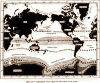 water by a transition layer (the main thermocline). Beneath the surface layer, we encounter the water types and water masses. Like air masses, the water types and water masses have source regions in which they form. Figure 1-2-4 is provided as a reference for the source regions of various water types and water masses. water by a transition layer (the main thermocline). Beneath the surface layer, we encounter the water types and water masses. Like air masses, the water types and water masses have source regions in which they form. Figure 1-2-4 is provided as a reference for the source regions of various water types and water masses. CENTRAL WATER MASSES. —Central water is normally found in relatively low latitudes although its source region is in the region of the subtropical convergence (between the 35th and 40th parallels in each hemisphere). Convergence are regions in the ocean where surface waters are brought together by the currents. In the western North Atlantic Ocean, a region of subtropical convergence exists where the Gulf Stream meets the colder, more dense Labrador current. Convergence are marked by rapidly rising sea-surface temperatures. Central water is not usually discernible at the surface and is generally relatively shallow. Its greatest thickness is observed along its western boundaries. In the western North Atlantic in the region of the Sargasso Sea, the thickness may reach 900 meters. Variations in heating and cooling, evaporation and precipitation, ocean circulation patterns, and mixing processes all contribute to the salinity values of central water being either quite similar or considerably different. For example, central water of the South Atlantic Ocean, the Indian Ocean, and the western South Pacific Ocean all have similar salinity values, while the salinity values of North Atlantic central water are considerably higher than the central water of the North Pacific Ocean. You will note as you look at figure 1-2-4 that the central water of the North and South Atlantic oceans is not separated by equatorial water like the central water of the North and South Pacific oceans. Instead, the central water of the North and South Atlantic come together and mix, forming a region of transition consisting of intermediate properties. EQUATORIAL WATER MASSES. —Equatorial water is found in the Pacific and in the Indian Ocean. In the Pacific it is thought to originate on the southern side of the equator. There are two reasons for this: Its properties are similar to those of the water masses of the South Pacific, and its salinity values are higher than those of the water masses found in the North Pacific Ocean.
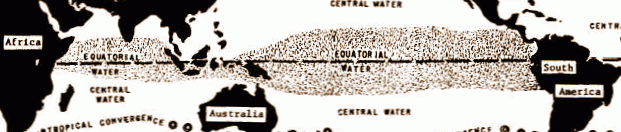 Equatorial water is also found in the northern part of the Indian Ocean. Here, its higher salinities are probably due to its mixing with the waters of the Red Sea. However, this conclusion has not been substantiated. Equatorial water, like central water, is not discernible at the surface, because the temperature and salinity values used to isolate it cannot be clearly ascertained in the upper 100 to 200 meters. Equatorial water is also found in the northern part of the Indian Ocean. Here, its higher salinities are probably due to its mixing with the waters of the Red Sea. However, this conclusion has not been substantiated. Equatorial water, like central water, is not discernible at the surface, because the temperature and salinity values used to isolate it cannot be clearly ascertained in the upper 100 to 200 meters.
INTERMEDIATE WATER. —Intermediate water is found below central water in all oceans. Intermediate water includes Antarctic intermediate water, Arctic intermediate water, Mediterranean water, and Red Sea water. Antarctic Intermediate Water. —Antarctic intermediate water encircles the Antarctic continent and is the most widespread of all the intermediate water masses. It forms in the vicinity of the Antarctic convergence, where it sinks. As it sinks, it flows north and mixes with the water masses that lie immediately above and below it. In the Atlantic, the absence of equatorial water allows Antarctic intermediate water to flow across the equator and reach roughly 20°N to 35°N latitude. In the South Pacific and Indian oceans, where equatorial water does exist, Antarctic intermediate water fails to reach the equator. It spreads north to about 10°S latitude. One of the characteristics of Antarctic intermediate water is its low salinity (34.1 ‰ to 34.6 ‰). In comparison to the water around it, it displays the lowest salinity values. 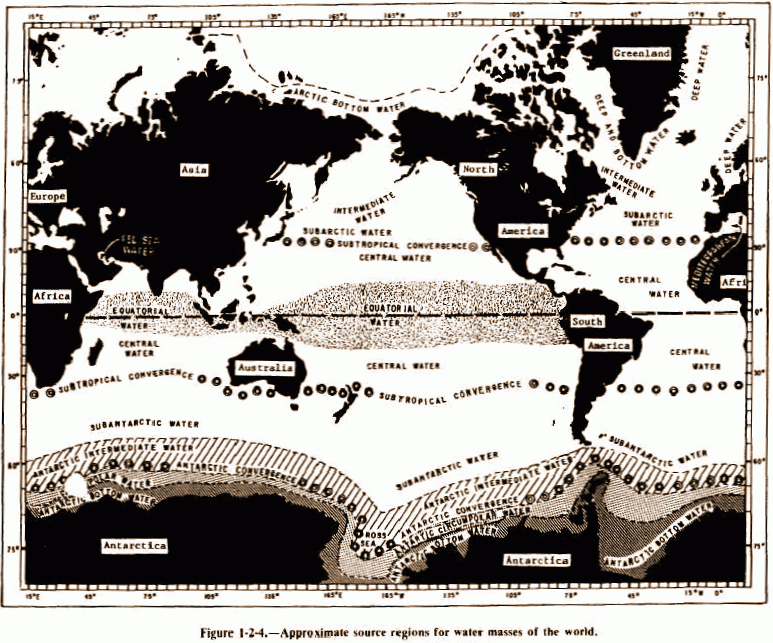 Arctic Intermediate Water. —Arctic intermediate water and sub-Arctic water are similar; however, in the North Atlantic Ocean, Arctic intermediate water forms only in small quantities, and in a relatively small area east of the Grand Banks of Newfoundland. In the North Pacific, Arctic intermediate water forms during winter at the convergence formed by the Oyashio current and the Kuroshio Extension. It exists between latitude 20°N and 43°N, except off the west coast of North America. Here, sub-Arctic water extends to lower latitudes, and the northern boundary of the intermediate water is pushed much farther south. Mediterranean Water. —This water mass is formed by the interaction of dense Mediterranean Sea water with waters of the adjacent North Atlantic Ocean. The more dense Mediterranean water flows out through the Strait of Gibraltar and sinks to a depth of about 1,000 meters, where it mixes with the water at this depth. Red Sea Water. —This water type is found over large parts of the equatorial and western regions of the Indian Ocean. Large quantities of warm, highly saline water from the Red Sea flow into the Indian Ocean, where its mixes with Antarctic intermediate water to form the Red Sea water mass. The spreading of Red Sea water is not as well-defined as Mediterranean water. ANTARCTIC CIRCUMPOLAR OR SUB-ANTARCTIC WATER. —This water mass is thought to form through a combination of mixing and vertical circulation in the region between the subtropical and Antarctic convergence. Here, large quantities of Antarctic intermediate water and Antarctic bottom water mix with North Atlantic deep water to form Antarctic circumpolar water. The physical properties of this water mass are quite conservative, and as its name implies, it extends completely around the Antarctic continent and the South Pole. Because Antarctic circumpolar water forms in the deeper waters of the Antarctic Ocean, it is often referred to as sub-Antarctic water. SUB-ARCTIC WATER MASSES. —Sub-arctic water is much like Antarctic circumpolar or sub-Antarctic water; however, there are differences. The differences are attributed to the land and sea distribution in the two hemispheres. In the Southern Hemisphere, the Antarctic convergence extends around the continent of Antarctica, but in the Northern Hemisphere, the Arctic convergence is found only in the western portions of oceans. However, even in these areas the convergence is not always well-defined. In the North Atlantic Ocean, sub-Arctic water covers a relatively small area, and it possesses a higher salinity than surrounding waters. On the other hand, the sub-Arctic water of the North Pacific is much more extensive, and its salinity values are lower than surrounding waters. DEEP AND BOTTOM WATER MASSES. — In the deep ocean basins below intermediate water, high density deep and bottom water exists. These water masses form in both hemispheres. In the Southern Hemisphere, Antarctic bottom water forms near the Antarctic continent, while in the Northern Hemisphere, Arctic deep and bottom water forms in northwestern Labrador Basin and in a small area off the southeast coast of Greenland. These water masses form at the surface, sink, and spread out to fill the deep-ocean basins. Deep and bottom waters are detectable in areas far removed from their source regions. More information on the spreading of deep and bottom water is presented in the following discussion on deep-ocean circulation.
|

