WAVESWind, atmospheric pressure changes, seismic disturbances (such as earthquakes), and tidal attraction of the Sun and Moon all generate waves. However, since wind-generated waves are the most common waves, our discussion will center around their development and decay.Wind waves are one of the elements created by the interaction of the atmosphere and the sea surface. From small wavelets to high seas (seas 12 feet or greater), wind waves are the result of the energy of the wind being imparted to the sea.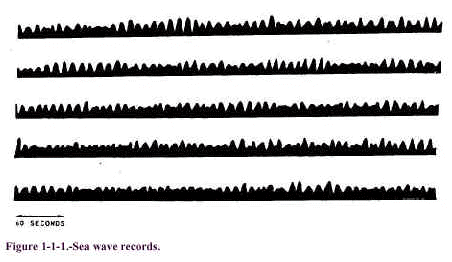 Waves of various proportions (heights and lengths) develop within a wave-generating area (a fetch). Figure 1-1-1 shows the variation in wind-wave heights as recorded by a wave-recording instrument. As you can see, the quite varied wave heights are random in nature. The height attained by wind waves is dependent on wind speed, the time the wind blows in one direction (duration), and the length of the fetch (the area over which the wind is blowing). Waves of various proportions (heights and lengths) develop within a wave-generating area (a fetch). Figure 1-1-1 shows the variation in wind-wave heights as recorded by a wave-recording instrument. As you can see, the quite varied wave heights are random in nature. The height attained by wind waves is dependent on wind speed, the time the wind blows in one direction (duration), and the length of the fetch (the area over which the wind is blowing).
When all of the wind’s energy is imparted to the sea within the fetch, the sea reaches a STEADY STATE. In a steady state, the waves are at their maximum height and are FULLY DEVELOPED for the prevailing wind speed. As an example, if over a calm (no wind) 60-nautical-mile stretch of ocean a 20-knot southwesterly wind develops, the water ripples and then small wavelets develop.Eventually, all the energy of the 20-knot wind is imparted to the sea, and the waves become fully developed. Table 1-1-1 shows the wind-sea relationship for fully developed seas. For a 20-knot wind, it takes a minimum of 10 hours for a fully developed sea of 5- to 10-foot waves to develop.When the wind is unable to impart its maximum energy to the waves, the sea does not fully develop. This can happen under two circumstances: (1) when the distance over which the wind blows is limited (the fetch is not long enough); or (2) when the wind is not in contact with the sea for a sufficient length of time (the wind hasn’t been blowing long enough).FETCH-LIMITED SEA. —When the fetch length is too short, the wind is not in contact with the waves over a distance sufficient to impart the maximum energy to the waves. The ranges of wave frequencies and heights are therefore limited. The wave frequencies are smaller and the wave heights are less than those of a fully developed sea. 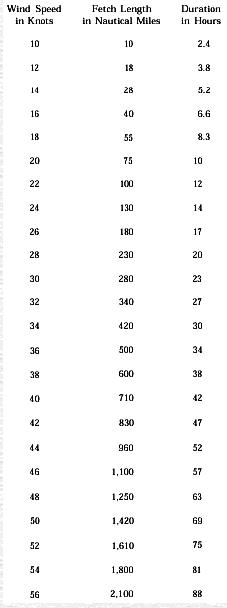 The wave generation process is cutoff before the maximum energy can be imparted to the waves and the fetch reaches a steady state. Therefore, for every wind speed, a minimum fetch distance is required for the waves to become fully developed. If this minimum fetch requirement is not met, the sea is fetch limited. The wave generation process is cutoff before the maximum energy can be imparted to the waves and the fetch reaches a steady state. Therefore, for every wind speed, a minimum fetch distance is required for the waves to become fully developed. If this minimum fetch requirement is not met, the sea is fetch limited.DURATION-LIMITED SEA. —When the wind is in contact with the sea for too short a period of time, it doesn’t have enough time to impart the maximum energy to the sea. Any increase in wave frequencies and heights ceases before a fully developed state-of-the-sea commences. When this occurs, the sea is duration (time) limited. Therefore, every wind speed requires a minimum time for waves to become fully developed. If this time requirement not met, the sea is duration limited. The state-of-the-sea classifications are as follows: fully developed, fetch limited, and duration limited. Table 1-1-2 shows the minimum wind durations and fetch lengths needed to generate fully developed sea states for various wind speeds. When actual conditions fail to meet these minimum requirements, wave properties such as frequencies, lengths, and heights are determined by means of graphs or formulas.Refer to table 1-1-1 again and notice that the wave height classifications are Average, Significant, and Highest 1/10. Average wave heights are based on the heights of all the waves observed, while significant wave heights pertain to the average height of the highest one-third of all the waves, and highest 1/10 pertains to the average height of the highest one-tenth of all the waves. In a fully developed fetch of 20-knot wind, average waves are 5 feet high, significant waves average 8 feet, and highest 1/10 average 10 feet. As wind waves move beyond the fetch, they become swell waves (also known as "swell"). The transformation of wind waves to swell waves also occurs when the wind over the fetch dies off.
|

